
SURVEYING SERVICES
Boundaries
Subdivision Design
Subdivision design is a critical part of the subdivision process i.e. it must be fully cognisant of site conditions including:
- Constraints including slope, vegetation, bushfire, bio diversity, flooding, landslide hazard overlays etc;
- Opportunities including views, breezes, solar access, physical access etc.; and
- Ability to service (sewer, water, electricity, NBN).
Good design will optimise the yield having considered the above constraints and opportunities, relevant Council requirements and intended market.
Subdivision Surveys
Surveys to create new lot boundaries by marking the new lot boundaries on the ground and depicting the survey on a subdivision Survey Plan capable of registration by the Department of Resources or Titles QLD. If it is land that is being subdivided the plan will generally be a Standard Format Plan. If it is a building that is being subdivided the plan will be a Building Format Plan. CadCon can also provide volumetric surveys and Survey Plans i.e. where the lot boundary is a three-dimensional figure e.g. as in some buildings and/or under some buildings.
Plan Sealing Applications to Councils
Before a plan of subdivision can register with Titles QLD it must be sealed or endorsed by the relevant Council. Prior to issuing plan sealing approval Council will check that all development conditions have been satisfactorily fulfilled and signed off (if applicable) by the correct person or entity (e.g. Unitywater, Council compliance officers, NBN, Energex, registered engineers, registered surveyors etc). As part of preparing and lodging a plan sealing application we provide a checklist to the client, collate all sign offs and other relevant paperwork and provide as-constructed information for inclusion in the application. We then liaise with Council to facilitate the best possible path through to approval. Plan sealing is one of the most critical components of the subdivision process.
Easement Surveys
Easement surveys are prepared to provide spatially delineated use rights for one lot in favour of another (e.g. access easements, stormwater easements, sewer easements etc). The easement must be surveyed and marked on the ground and a Survey Plan prepared that is suitable for registration by Titles QLD or Department of Resources.
Identification Surveys
Identification Surveys resurvey all or part of an existing lot’s boundaries by way of surveying, reinstating and marking the corners of the lot boundaries and depicting the results of the survey on an Identification Survey plan suitable for lodgement with Department of Resources. These surveys are required for construction of new fences; erection of a structure, including retaining walls, on or close to a boundary; and for certainty in design i.e. ensuring the boundaries used in the design actually exist on the ground prior to commencing costly and time-consuming design.
Location Certificates
A site inspection and survey to accurately locate any and all encumbrances on a lot. Often used to satisfy a due diligence period prior to the purchase of a property, a location certificate can provide clarity and confirmation for the purchase. Unlike an Identification Survey, a location certificate does not provide marked boundary corners but provides enough accuracy to determine the location of anything that may cause boundary encroachment issues down the track.
Lease Surveys
Surveys to enable issue of a Lease (for part of land or part of a building) by QLD Titles or the Department of Resources. Surveys result in a Survey Plan or sketch plan suitable for registration by Titles Qld or Department of Resources.

Construction
(Building and/or Civil)
Detail Surveys for Design
This type of survey measures all of the surface features and changes of grade on the subject land and is required for building and other design purposes. Whilst this type of survey doesn’t “fix” the boundaries (see Boundary Surveys), it does accurately compile the boundaries from the title plan. The resultant plan includes compiled boundaries, contours, significant trees and vegetation, fences, retaining walls, kerb and channel, and services surface features (e.g. Telstra, Energex, Unitywater, etc), buildings and the like. A 3D digital model is also provided for use by professional designers.
Lawful Ground Level Determination
Planning schemes ordinarily set the maximum allowable building height as a distance above lawful ground level i.e. the ground level surface as it was at the time of the approved subdivision. Determination of this surface requires the experience and expertise of CadCon’s Cadastral Surveyors.
Setout Surveys
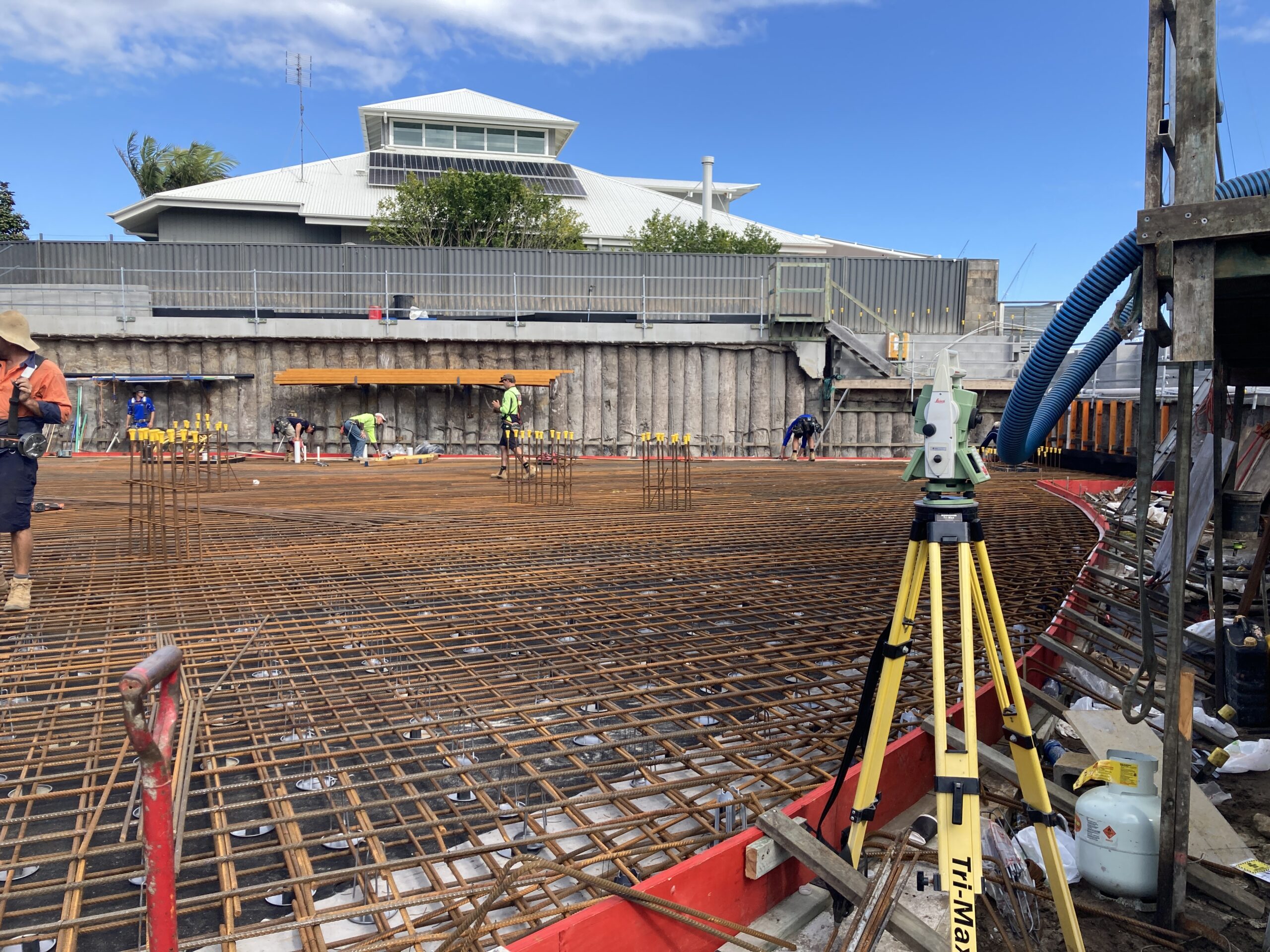
Accurate survey setout is becoming more and more integral to successful construction projects. Survey ensures projects are located accurately with respect to boundaries, design position and Australian Height Datum. Further, accurate survey setout allows us to issue compliance certificates by way of Form 12s for position and height as required by the significant majority of Certifiers for the significant majority of projects.
Volume Surveys
CadCon is able to measure a pre-works surface and a post-works surface then model the differences between the two and provide an accurate, certifiable volume calculation for clients. This provides certainty for our clients in the payment of claims and obtaining sign off certification.
As Constructed and ADAC Surveys for Design or Compliance
Most Council approvals will require as-constructed surveys, plans and accuracy compliance signatures as part of a development approval, to be delivered as part of the plan sealing process. South East Qld Council’s in particular require this to be delivered in the ADAC format i.e. “Asset Design As Constructed” format which CadCon can provide.
Other regulatory bodies also require as-constructed survey for compliance checking purposes, as do some Certifiers for approved structures.
These surveys, and the date presentation thereof, need to be very accurate and presented in specific formats to ensure timely sign off by regulatory and other authorities. CadCon’s experience and expertise is critical in the provision of this information.
Monitoring and Deformation Surveys
Retaining walls move over time, no matter what they are constructed of. CadCon can measure the exact three-dimensional position of a retaining wall at a given date and repeat these same measurements into the future, thereby providing an accurate measurement of movement over time. This allows decisions to be made about rectification works etc. Usually, the wall is surveyed with respect to the property boundary and so movement into or out of a property can also be described.
New building work, demolishing or piling works can cause cracks and movement in neighbouring buildings. Prudent builders instruct CadCon to undertake an accurate as-constructed survey of adjoining buildings that could be affected PRIOR to commencing construction. We leave survey control offsite so we can repeat the measurements over time which enables us to provide a report to our client stating exactly what, if any, movement has occurred. Benefits to the client include early warning and avoidance of disputes over whether movement has occurred and if so, what is the extent of the movement.

3D Laser Scanning
3D Laser Scanning provides an accurate measure-up of existing buildings, both internal and external, for use by design consultants (e.g. architects, building designers, interior designers, landscape architects, etc), in the creation of both 3D design and 2D floor plans for new construction projects, renovations and redevelopments.
The laser scanner captures millions of points creating a crust-like layer of points (known as a point cloud) over every object or surface being scanned. 3D point cloud files can be provided in various formats for interoperability with various CAD software programs such as Revit, Recap Pro and BricsCAD to suit design consultants.

Underground Service Location (USL)
CadCon’s Ground Penetrating Radar and Underground Services Location equipment, when coupled with a traditional detail survey, can be used to ensure design will not impact on existing services in the area. This is critical to keep a project moving forward and can save what can be significant downtime and repair costs if not undertaken prior to construction commencing.
It is also important from a construction safety perspective that the location of underground services is known and therefore not impacted on during the construction process, both from a project and neighbouring residents perspective.